
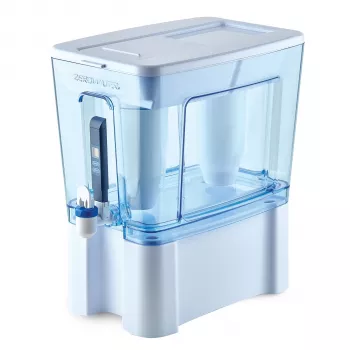
A large-capacity countertop dispenser can simplify daily hydration by keeping filtered water ready for cooking, coffee, and quick refills. The 52-Cup 5-Stage Water Filter Dispenser with Real-Time TDS Meter & Lead Reduction combines multi-stage filtration with a real-time TDS display to help track changes in your water over time. Below is a practical guide to what a 5-stage system generally does, what a TDS readout can (and can’t) indicate, and what to look for when lead reduction matters.
“5-stage” usually means the filtration media is layered so each stage addresses a different type of problem. Earlier stages tend to capture bigger particles so later stages can focus on finer polishing and specialized reduction media. Actual performance depends on contact time, your water chemistry, the cartridge design, and replacing filters on schedule.
| Stage | Primary role | Examples of what may be reduced |
|---|---|---|
| Pre-filter (sediment) | Captures larger particles | Sand, rust, silt |
| Activated carbon (taste/odor) | Adsorbs chlorine-related compounds | Chlorine taste/odor, some VOCs |
| Fine filtration layer | Helps polish smaller particulates | Fine sediment, turbidity |
| Lead-reduction media | Targets specific heavy metals | Lead (Pb), depending on media and certification |
| Final polishing | Stabilizes taste and clarity | Residual odors, minor particulates |
One advantage of a stacked design is longevity: by intercepting grit early, later media can stay effective longer. That said, a clogged pre-filter can also slow flow, so timely replacement matters for both performance and convenience.
TDS stands for total dissolved solids. A TDS meter estimates dissolved ion content by measuring water conductivity—commonly influenced by minerals and salts like calcium, magnesium, sodium, and bicarbonates. In everyday terms, it’s a quick “trend” tool rather than a direct safety measurement.
Lead in drinking water is frequently associated with plumbing materials and can vary by building, neighborhood, and even time of day. Homes with older plumbing, certain fixtures, or disturbed pipes can see different levels than a neighbor on the same street. For background and risk context, see the CDC’s information on lead in drinking water and the EPA’s lead drinking water overview.
| Option | Best for | Trade-offs |
|---|---|---|
| Large dispenser | High daily volume without installation | Takes counter/fridge space; filter changes required |
| Pitcher | Small households and tight spaces | Frequent refills; smaller capacity |
| Under-sink filter | Higher flow for cooking and drinking | Installation and plumbing compatibility |
| Reverse osmosis | Large TDS reduction goals | Higher cost; wastewater; more maintenance |
The 52-Cup 5-Stage Water Filter Dispenser with Real-Time TDS Meter & Lead Reduction is available while supplies last. Before ordering, confirm it fits your intended space and review replacement filter availability and recommended change intervals to plan ongoing costs.
Yes—some systems reduce TDS, but the biggest reductions typically come from reverse osmosis or distillation. Many carbon-based dispensers focus more on taste/odor improvement and reduction of select contaminants, while a TDS meter is best used to monitor trends rather than prove removal of specific substances.
Reverse osmosis systems are commonly associated with around 90% (or higher) TDS reduction, depending on membrane quality, water pressure, and water chemistry. Real-world results vary, so verified testing and certifications are the most reliable way to compare performance.




Leave a comment