
A social media marketing funnel turns attention into action by guiding people through clear stages: discovering a brand, engaging with helpful content, building trust, and finally converting into subscribers or buyers. The strongest funnels feel natural inside the feed—each post, story, or message nudges the next step while keeping the experience valuable and human. For more guidance, see A Comprehensive List of the Best Demand Generation Tools of 2023.
A social media marketing funnel is the path someone takes from “Who is this?” to “I trust this” to “I’m ready.” The key is designing a sequence of small commitments—watching a Reel, saving a checklist, replying to a story—rather than asking for one big leap to purchase right away. For further reading, see [PDF] eMarketing: The essential guide to marketing in a digital world.
It’s also not a rigid template. A funnel on TikTok might move fast (high reach, quick DM intent), while Instagram might rely more on carousels, stories, and highlights to build trust. LinkedIn may require more depth and longer consideration windows. Your audience’s price sensitivity, product type, and platform habits should decide the steps and timing.
Most importantly, a social funnel blends content and conversion. Content earns attention and signals relevance; conversion tools (links, lead magnets, product pages, and DMs) capture intent while it’s hot. When done well, funnels reduce randomness by connecting what you post to outcomes you can measure—clicks, sign-ups, purchases, and repeat orders.
Think of your funnel like a guided tour: each stop answers a question your customer is already asking. The format changes, but the logic stays the same.
| Stage | Primary goal | Best-fit content | Typical next step |
|---|---|---|---|
| Awareness | Introduce the problem and position | Reels/Shorts, carousels, trend-based posts | Profile visit or follow |
| Engagement | Start a relationship | How-to posts, behind-the-scenes, interactive stories/polls | Save/share/comment |
| Consideration | Build trust and reduce doubt | Testimonials, case studies, live Q&A, comparison posts | Click to landing page or DM |
| Conversion | Get the commitment | Offer posts, limited-time bonuses, pinned posts, DM automation prompts | Purchase/booking/opt-in |
| Retention | Increase LTV and referrals | Customer spotlights, onboarding tips, community posts | Repeat purchase/referral |
Awareness wins with high-clarity hooks: a relatable problem, a bold myth-bust, or a quick “before you do X, do this.” Engagement turns the initial spark into interaction—saves, shares, and watch time—by making your content genuinely useful or emotionally resonant. Consideration is where proof matters: testimonials, customer journeys, comparisons, and FAQs that reduce doubt. Conversion is a clear next step—checkout, booking, opt-in, or a DM keyword—paired with frictionless pages and follow-up. Retention is what turns a buyer into a repeat buyer: onboarding, community, post-purchase support, and moments that invite advocacy.
Funnels perform best when the foundation is simple enough to repeat consistently.
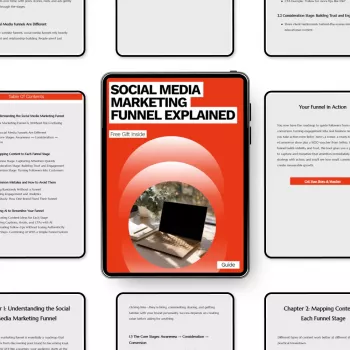
If you want a plug-and-play reference for structuring stages, CTAs, and content types, Social Media Marketing Funnel Explained – Ultimate Guide to Mastering Funnels, Boost Engagement & Convert Followers is a fast way to tighten your funnel without overcomplicating your posting schedule.
Strong funnels don’t rely on “more content.” They rely on the right content at the right moment.
Going live (or filming clear short-form tutorials) often boosts consideration and conversion—confidence on camera makes your value easier to trust. If presenting is a bottleneck, Speak Confidently in Any Situation – Practical Guide on how to improve public speaking confidence | Digital Download can help tighten delivery for Lives, product explainers, and Q&A sessions.
For platform-specific setup and troubleshooting, use the official resources from Meta Business Help Center and TikTok Business Help Center. For clean measurement and attribution basics, Google Analytics Help is a reliable reference.
It’s a simple content balance: roughly 50% value (education/entertainment), 30% community (conversation, polls, behind-the-scenes), and 20% promotion. It maps neatly to funnel stages—value fuels awareness and engagement, community builds consideration, and promotion drives conversion without feeling abrupt.
Social media marketing builds awareness, earns trust through consistent value, and drives action through clear CTAs that lead to traffic, leads, and sales. It also supports retention by keeping customers engaged after purchase through community, updates, and ongoing support.






Leave a comment