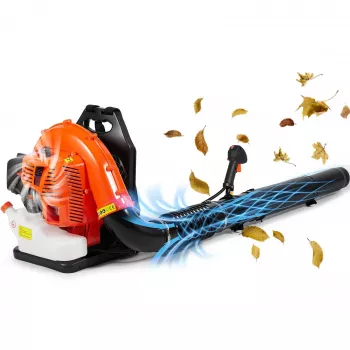
When leaves cover a broad lawn or collect along a long driveway, getting them into manageable piles can take time. Our Backpack Gas Leaf Blower pairs a listed 79cc 2-cycle engine with a 3L fuel tank and a 930 CFM air-volume rating. Those numbers offer useful comparison points, but the way you plan your cleanup matters, too.
Engine displacement, measured in cubic centimeters (cc), describes engine size. The 79cc figure identifies this blower’s engine displacement; it does not, on its own, tell you how quickly you’ll clear your yard.
CFM stands for cubic feet per minute. It measures air volume, or how much air a blower is rated to move. The listed 930 CFM rating helps you compare airflow volume with other blowers, but it is not an air-speed rating or a promise that a particular pile will move in one pass. Dry, loose leaves behave differently from wet, compacted ones, and your technique affects the result.
The 3L specification is fuel-tank capacity, not guaranteed runtime. Fuel consumption varies with operating conditions and throttle use. You can review these specifications together on our Backpack Gas Leaf Blower 79CC 2-Cycle with 3L Tank & 930CFM Air Volume product page.
| Specification | Listed value | Why it matters |
|---|---|---|
| Engine | 79cc, 2-cycle | Identifies engine displacement and engine type |
| Fuel tank | 3L | Shows how much fuel the tank holds |
| Air volume | 930 CFM | Indicates the blower’s listed airflow volume |
A backpack blower can be a practical choice when you have a larger lawn, an extended path, or seasonal leaf buildup that calls for repeated cleanup. Wearing the unit on your back lets you direct the airflow as you walk through the work area. Whether that arrangement suits you depends on the space you maintain and how comfortable you are using gas-powered equipment.
Before starting, choose where the leaves should end up. Look at the direction you’ll travel and aim to move debris toward a collection area rather than back across ground you’ve cleared. If leaves are wet or pressed into thick patches, loosen them or work in smaller groups. Airflow alone may not shift every heavy pile at once.
Start at the far edge of the work area and work toward your chosen collection point. For scattered, dry leaves, use broad, controlled passes to bring them together. Then switch to shorter passes to gather what remains along edges or in thinner patches. Keeping your movements deliberate can help you avoid repeatedly blowing the same leaves from one side of the yard to the other.
For a large yard, divide the space into sections. Build smaller piles as you finish each section, then consolidate them where you can collect the leaves. Pay attention to obstacles and changes in surface: leaves on an open lawn may move differently from material caught beside a curb or fence.
Keep the airflow directed away from people, pets, vehicles, and loose objects. Do not blow debris into streets or storm drains. If wind begins carrying leaves away from your collection point, adjust your route or pause until you can keep the material under control.
Because this is a 2-cycle blower, follow the supplied instructions for its fuel and oil requirements, including the specified mixture ratio. Do not guess at a ratio. Before a work session, make sure you have the correct fuel preparation and a clear place to operate. To refuel, shut the engine off and let it cool first; refuel in a well-ventilated area away from ignition sources.
Adjust the backpack fit before you begin so it sits securely while you move. Take breaks during extended sessions, especially if you notice fatigue affecting how steadily you can aim the blower. Wear eye protection and suitable hearing protection. Everyday listening earbuds—including our High-Fidelity 9.2mm Beryllium-Coated Single Driver In-Ear Headphones—are not a substitute for hearing protection selected for noisy equipment. For background on noise exposure and hearing conservation, see the Occupational Safety and Health Administration’s noise guidance.
Follow your local rules on when gas-powered blowers may be used. A quick check before you start can help you plan your work for permitted hours and avoid interrupting a cleanup midway through.
Bring the decision back to your routine. How much ground do you cover, how often do leaves accumulate, and do you want a gas-powered backpack design for that work? The listed 79cc engine, 3L tank, and 930 CFM air volume give you concrete specifications to compare, without turning any single number into a promise of runtime or clearing speed.
If that combination fits the cleanups ahead, view the blower’s product details and decide whether it belongs in your yard-care routine.
It is the blower’s listed air-volume rating, indicating how much air it is rated to move. It does not guarantee a particular clearing time or describe air speed by itself.
No. It states how much fuel the tank holds; runtime depends on fuel consumption and how you operate the blower.
Follow the blower’s supplied instructions for its fuel and oil requirements and specified mixture ratio. Do not assume a ratio.





Leave a comment