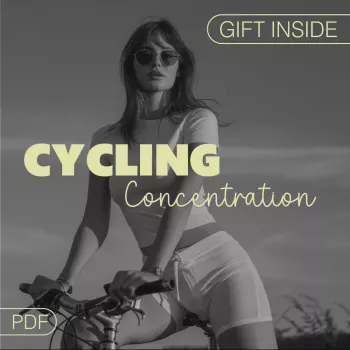
A strong ride isn’t only legs and lungs—it’s attention. When focus slips, cadence gets choppy, lines get messy, and small decisions start costing energy. Our Focus & Flow routine is a practical concentration checklist designed to help you settle your mind, sharpen awareness, and stay steady from roll-out to cool-down—whether your goal is safer commuting, smoother group rides, or more intentional training.
On the bike, focus is quiet, repeatable decision-making: holding a clean line, scanning ahead, choosing gears early, and responding without panic. It isn’t constant intensity or trying to “lock in” forever—it’s your ability to return attention to the next useful cue (breath, cadence, traffic, terrain) whenever your mind wanders.
A checklist works because it reduces mental load. Fewer last-second choices means more clarity when the ride gets complex. Use Focus & Flow like a reset button before you roll and a quick reference whenever attention drifts mid-ride.
| Moment | Time needed | What to do | Result to look for |
|---|---|---|---|
| Pre-ride (before rolling) | 2–4 minutes | Set one ride intention, run a quick body scan, choose 1–2 focus cues (breath/cadence/line), confirm essentials | Calm start, fewer “forgot something” distractions |
| First 10 minutes | 30–60 seconds | Ease into rhythm, match breathing to effort, soften grip/shoulders, scan ahead | Smooth pacing, less jittery steering |
| Mid-ride reset | 15–30 seconds | Notice wandering thoughts, name the next cue, return to it for 10 pedal strokes | Attention snaps back without overcorrecting |
| Climbs/headwinds | 30–90 seconds | Break effort into micro-targets (next bend/marker), repeat a short mantra, check form | More consistent output, less mental spiraling |
| Technical sections/traffic | 5–10 seconds | Widen vision, prioritize hazards, keep braking/turning decisions early | Cleaner lines and safer spacing |
| Post-ride | 2 minutes | Quick debrief: what cue worked, what broke focus, one adjustment next time | Faster progress and better confidence |
“Stay focused” is a vague instruction. Our team built Focus & Flow to translate that idea into cues you can actually execute while riding—like a breathing rhythm, relaxed hands, eyes up, or a steadier cadence sound.
When you repeat the same simple steps, you create a reliable starting ritual, and your mind learns to associate roll-out with calm readiness. Over time you build an “attention loop” that stays lightweight enough for real roads: notice → choose cue → return → repeat. That loop also helps prevent mental fatigue by limiting how many things you try to manage at once, while keeping your awareness anchored to your environment instead of internal noise. For more background on mindfulness skills in everyday performance, see the American Psychological Association’s overview (APA — Mindfulness) and the NIH/NCCIH guide (NCCIH — Meditation and Mindfulness).
Choose one intention that you can feel on the bike: smooth, steady, alert, patient, or playful. Keep it short and measurable—something you can check in on at a stoplight or the start of a climb.
Internal anchors: exhale length, jaw/shoulder tension, grip pressure. External anchors: line choice, scanning, the sound/feel of a consistent cadence. With two anchors, you have options without juggling ten ideas.
Set a repeatable trigger: every stoplight, every climb start, or every 10 minutes. Your reset can be as small as “soft hands, eyes up” for 10 pedal strokes.
Distraction isn’t failure; it’s your cue to run the loop. Name what matters next (breath, line, scan), return to it briefly, and let the rest go.
End with a fast review: one win, one tweak, one cue to reuse next ride. This is where confidence stacks up, because you keep what works and stop repeating what doesn’t.
Commuting: Use it to prioritize hazard scanning, calm braking decisions, and patience under stop-and-go stress. If you want a safety refresher to pair with your focus work, the CDC’s bicycle safety guidance is a solid baseline (CDC — Bicycle Safety).
Plan on about 2–4 minutes. If you’re short on time, a 30–60 second version still works: pick one intention, choose one cue, soften your grip, and start scanning early.
Yes—anchors and micro-resets reduce overwhelm by giving you a single next action instead of a swirl of worries. Focus on breathing, eyes up scanning, and making braking/line decisions earlier, and keep it safety-first rather than trying to “power through” anxiety.
Try a simple internal cue: lengthen your exhale or count your cadence for 10 pedal strokes. Then add one external cue—eyes up and scan ahead—to keep your attention connected to the road environment.







Leave a comment