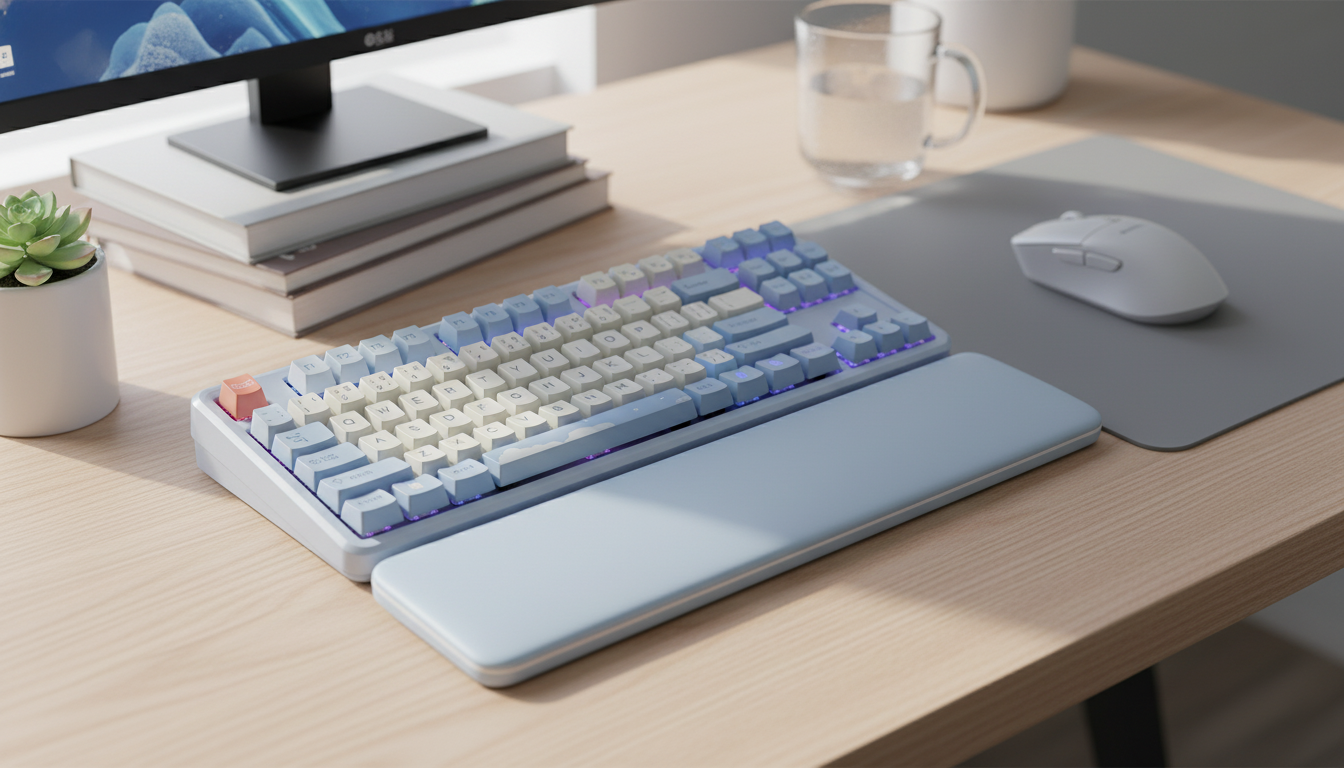
A wireless mechanical keyboard can still feel competitive for gaming and comfortable for long sessions when it combines stable connectivity with a cushioned, controlled typing feel. This model pairs a gasket-mounted build with full RGB lighting and an included wrist rest to support fast inputs, reduced fatigue, and a cleaner sound profile—whether it’s used in a dedicated desktop setup or a shared workstation.
Not every wireless board is built with long-session comfort in mind. This one focuses on feel, sound, and usability features that matter daily—then layers in RGB and wireless freedom for modern setups.
Gasket mounting is often chosen for a less harsh keystroke and a more refined sound. Instead of feeling like the plate is rigidly bolted into a hollow case, a gasket structure typically isolates the plate/PCB from the case so impacts feel more cushioned.
For comfort, aim for a position where your shoulders stay relaxed, elbows are near 90 degrees, and your wrists aren’t bent upward to reach the home row. If the wrist rest sits slightly lower than the front edge of the keyboard, it can encourage a steadier, less tense hand position over time.
Wireless is about more than removing a cable—it’s the ability to place the keyboard where it’s most comfortable, route fewer wires across a desk, or use a living-room PC setup without stretching peripherals. Still, responsiveness depends heavily on the connection mode and environment.
For a practical reference on Bluetooth capabilities and profiles, see the Bluetooth Core Specification Overview (Bluetooth SIG). And since keyboards communicate as standard HID devices, the USB HID (Human Interface Device) Class Overview (USB-IF) is a helpful overview of how input devices are defined across systems.
RGB can be more than desk ambience. In dim rooms, it helps with visibility, and for games or workflows, it can highlight a cluster of frequently used keys. The trick is choosing effects that stay readable and don’t drain the battery unnecessarily.
A useful approach is to keep a bright profile only when you need it (late-night or mood lighting), then run a low-brightness static color for most sessions. That keeps the board looking clean while extending time between charges.
Switch type shapes how the keyboard feels at speed, while stabilizers determine how “premium” the large keys feel. Even a fast switch can feel distracting if the spacebar rattles or the Enter key sounds inconsistent.
| Feature | Why it matters | What to verify |
|---|---|---|
| Gasket mount | Softer bottom-out feel and reduced resonance | Consistent cushioned feel across the board; minimal case ping |
| Wrist rest | Comfort and steadier hand position | Height alignment; non-slip base; easy cleaning |
| Wireless mode(s) | Latency and convenience | 2.4 GHz dongle availability; Bluetooth pairing stability; range |
| RGB controls | Visibility and personalization | Onboard shortcuts; profile memory; brightness steps |
| Stabilizers | Spacebar/Enter feel and sound | Low rattle; even key travel; minimal ticking |
| Charging behavior | Downtime prevention | Use-while-charging support; charge indicator clarity |
Gaming performance depends most on switch behavior and connection latency, while gasket mount mainly improves typing feel and acoustics. Some players prefer a firmer, more rigid bottom-out, but many enjoy the reduced harshness during long sessions.
Yes. Higher brightness and animated effects draw more power, so lowering brightness, using static lighting, or turning RGB off can significantly extend time between charges.
Use the lowest-latency wireless mode available, keep the receiver close to the keyboard, minimize interference, and keep firmware updated. For critical sessions, switching to wired mode can provide the most consistent responsiveness.






Leave a comment