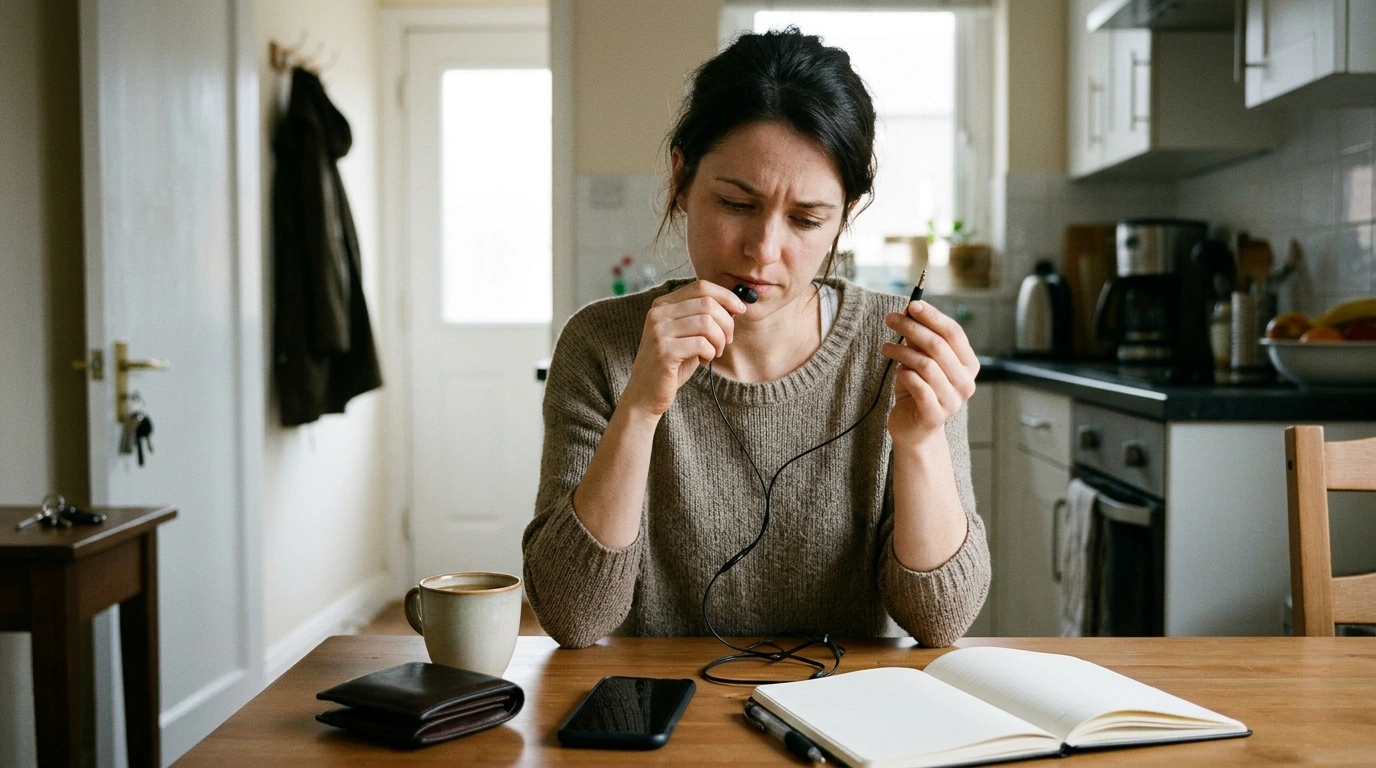
You have ten minutes before leaving home, and your headphones stop working. Do you replace them today, borrow a pair, or see whether a simple fix will do? It is a small decision, but the familiar rush to solve it can make the first option feel like the only option. Better thinking often begins with a pause: What am I actually trying to solve?
We created our Think Smarter digital checklist for people who want that pause to become a more consistent habit. You do not need a perfect memory or a complicated routine. You need a useful question and enough room to act on the answer.
When you rush to compare options, you can miss the decision underneath them. In the headphone example, “Which pair should I buy?” assumes you need to buy a pair at all. The more useful question might be, “How do I get through today’s commute?” That leaves room for a repair, a borrowed pair, or a purchase.
Before an important choice, write one sentence naming what you need to decide and why it matters. Then try three questions you can use almost anywhere:
You do not have to question everything endlessly. The point is to give a consequential choice a clearer starting point. If the decision is small and easily reversible, one quick question may be enough. If it affects your budget, time, or another person, give it a little more attention.
A habit is most useful when you can repeat it during an ordinary day, not just when you have an uninterrupted hour to reflect. Use this table as a quick reference when you recognize a common thinking trap. Pick the row that fits; you do not need to run through every question each time.
| When you notice… | Ask yourself… | Try this next |
|---|---|---|
| A snap judgment | What information am I missing? | Find one relevant fact before deciding. |
| Too many options | Which two criteria matter most? | Compare the options against those criteria. |
| A strong reaction | Am I responding to the facts or the feeling? | Pause, then describe the situation neutrally. |
| A decision that keeps circling | What is the smallest useful next step? | Set a point at which you will decide or reassess. |
Suppose you decide new headphones are worth considering. Before opening a dozen tabs, choose the two criteria that matter most to you, such as your budget and whether you prefer an in-ear design. If you are considering our High-Fidelity 9.2mm Beryllium-Coated Single Driver In-Ear Headphones, compare that option against your criteria rather than treating every feature as equally important. The same approach works for decisions that have nothing to do with shopping: limit the comparison to what will actually guide your next step.
Small, repeatable questions have a place in broader work on thinking. Harvard Project Zero offers thinking routines designed to make thought more visible, while the Stanford Encyclopedia of Philosophy’s discussion of critical thinking explores careful judgment. You can draw on those ideas without turning every everyday choice into a research project.
Considering an alternative does not mean you must abandon your view. It gives you a chance to spot a gap before you commit. Try this brief exercise when a decision matters and you feel certain about your answer:
For example, you might prefer to replace a device immediately because it has failed twice. The strongest case for waiting could be that both failures have a simple, inexpensive fix. One useful next step is to find out whether the fault can be identified today. You are not required to wait forever for perfect information; you are looking for information that could change the decision.
Open-mindedness and indecision are not the same thing. Give another perspective a fair hearing, then choose a time to act or reassess. A deadline can keep reflection from becoming another way to put off a difficult choice.
Good thinking does not end when you choose. After a meaningful decision, take a minute to ask: What worked? What surprised me? What would I do differently next time? Keep your answers specific. “I compared too many minor details” gives you something to adjust; “I am bad at decisions” does not.
If you would like a dedicated reminder to practice, our Think Smarter: Your Action-Packed Checklist to Becoming a Better Thinker is a digital download listed at $5.99. Our team sees it as an optional companion to the habit you build in real life: pausing, asking a useful question, and choosing a next step.
Start with one repeatable habit, such as naming the decision, checking an assumption, or considering one alternative before acting.
No. A brief pause and a well-chosen question can be more practical than an elaborate routine, especially for everyday choices.
Think Smarter: Your Action-Packed Checklist to Becoming a Better Thinker is our digital download. It is an optional guide for practicing better thinking habits.







Leave a comment