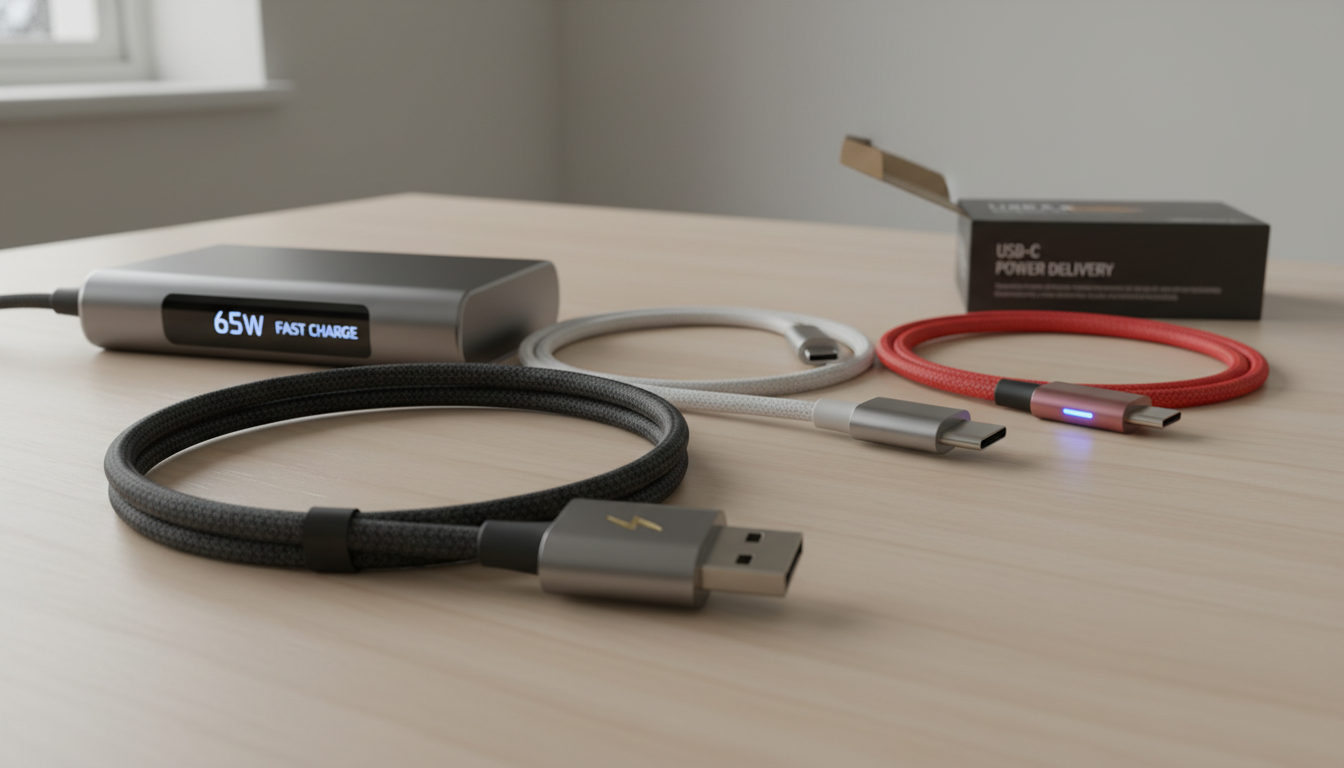
Not every USB-C cable charges at the same speed. Many look identical, but the internal wiring and the power rating determine whether it can deliver fast charging—or only slow top-ups. To identify a fast charging USB-C (Type C) cable, check the markings, specs, and real-world behavior using a compatible charger and device.
Start with the cable jacket and packaging. A true fast charging USB-C cable often lists a power rating such as 60W, 100W, or a current rating like 3A or 5A. For higher-power USB-C Power Delivery (PD) charging (typically above 60W), a quality cable usually includes an “e-marker” chip that communicates its capabilities to the charger and device. If the listing or package mentions “PD,” “USB-C PD,” “E-Marked,” “5A,” “100W,” or “240W,” that’s a strong indicator it’s built for fast charging.
Fast charging cables commonly use thicker power conductors to safely carry higher current, so they may feel slightly more robust. Well-made connectors, snug fit, and strain relief reduce resistance and heat. However, appearance isn’t proof—some thin cables are well-engineered, and some thick ones are not.
The most reliable test is measuring wattage. Plug the cable between a USB-C PD charger and a device that supports fast charging, then use a USB-C power meter to read volts/amps/watts. If your phone or laptop supports fast charging and the cable is capable, you’ll see higher wattage (often 18W–45W+ for phones, and 45W–100W+ for laptops, depending on the device and charger).
If a cable is labeled “charging cable” with no wattage, only supports USB-A to USB-C fast charging claims, or gets unusually warm at moderate power, it may not be designed for sustained fast charging. Also, some cables charge fast but only offer USB 2.0 data speeds—fast charging and fast data are separate specs.
For a practical example of a high-power option and what the specs mean, see this guide: 60W USB-C to USB-C rotating cable (3A) fast charging guide.
No. A cable can be rated for high-watt charging yet still be limited to slower USB 2.0 data speeds; data performance depends on the cable’s USB spec (USB 3.x/USB4) and how it’s built.







Leave a comment